Industry News · Oct 19, 2026
A substation is a vital part of the power system. It transforms voltage levels and integrates switching, protection, control, and measurement functions to ensure safe and reliable power transmission and distribution.
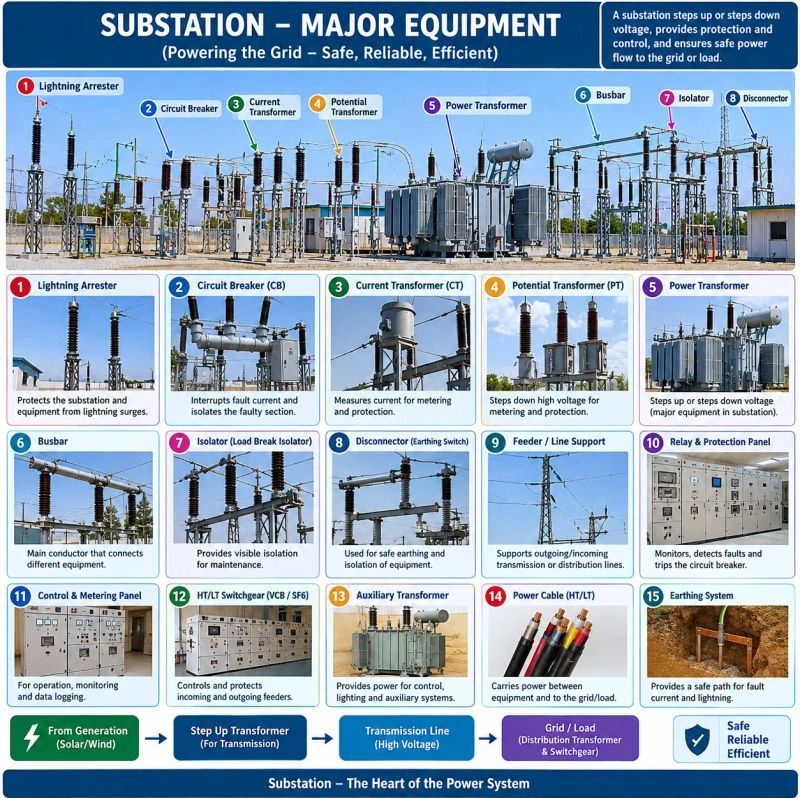
Electrical substations rely on a range of essential equipment to control power flow, transform voltage, measure electrical parameters, and protect the power system. This guide introduces 15 major substation components, explains their functions, and highlights how they work together to support safe and reliable electricity transmission and distribution.
Industry News
Key Substation Equipment Includes: • Power Transformer – Steps voltage up or down according to system requirements • Circuit Breaker – Interrupts fault currents and switches electrical circuits • Isolator / Disconnector – Provides electrical isolation for maintenance • Lightning Arrester – Protects equipment against lightning and switching surges • Current Transformer (CT) – Measures current for metering and protection • Potential Transformer (PT/CVT) – Provides voltage signals for measurement and protection • Busbar – Connects incoming and outgoing circuits • Protection & Relay Panel – Detects faults and initiates protective actions • Control & Metering Panel – Supports monitoring, operation, and measurement • HT/LT Switchgear – Controls and protects electrical distribution circuits • Auxiliary Transformer – Supplies power to substation auxiliary systems • Earthing System – Provides a safe path for fault current Other essential components include power cables, battery systems, chargers, and SCADA/communication systems. Each component has a specific role, but reliable substation operation depends on how all these systems work together.
Need product selection support, drawings review, or a BOQ quotation?
Submit RFQ